
Risk & compliance
Why beginners should wait before using crypto leverage
Liquidation, funding, and emotional amplification—why spot literacy should come first.
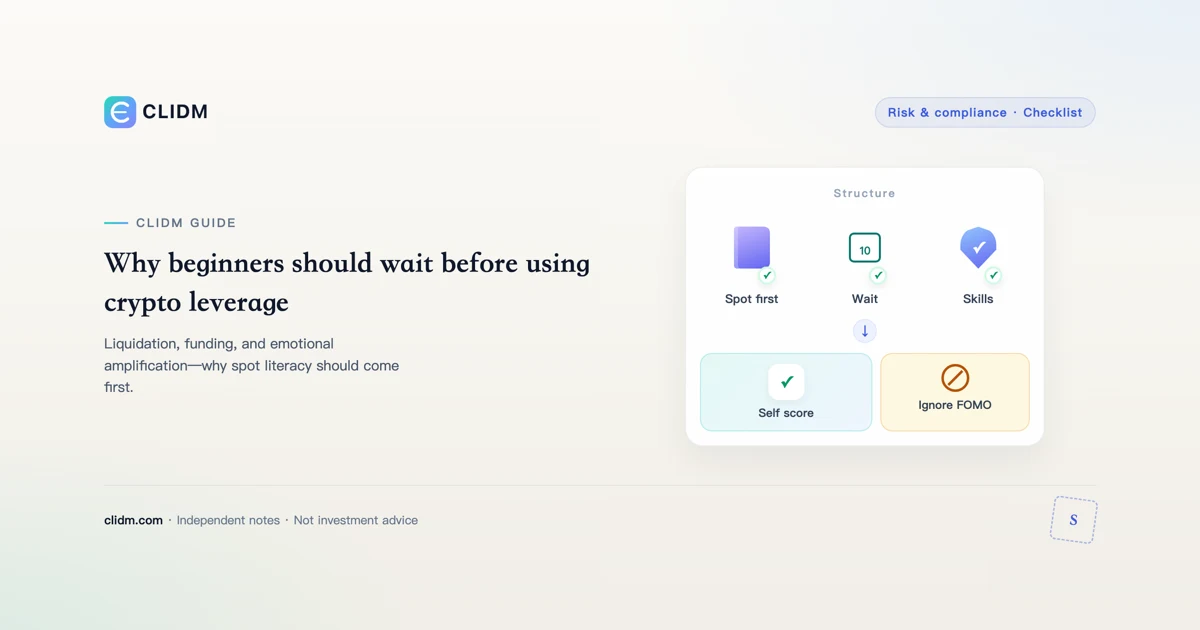
Beginners: wait before leverage—a deliberate delay policy
Waiting is not fear. Waiting is a policy that keeps learning capital alive long enough to compound skill.
Why wait
Leverage compresses time-to-consequence. Beginners still make domain mistakes, 2FA mistakes, unit mistakes, and emotional mistakes on spot. Adding leverage multiplies every unfinished skill.
Minimum competencies before any futures UI curiosity
- Domain + phishing hygiene
- Account security stack
- Spot order literacy (first spot, market vs limit)
- Fee reading (trading fees)
- Ability to refuse social signals
30-day delay template
Days 1–10: security and deposits/withdrawals tests. Days 11–20: tiny spot only with journals. Days 21–30: explain liquidation and margin modes on paper (liquidation, myths). No live leverage.
If you still open the futures screen
Use platform minimum size, isolated if available, session timer, written stop of the experiment. Prefer deleting the icon for 30 days if urge exceeds plan.
Extra self-check
Before size increases, restate your maximum loss in cash terms and confirm the official domain character-by-character. If either step feels annoying, that annoyance is protective friction—keep it.
If you are still at registration mindset, stay there

Leverage is optional for almost every educational goal.
Why waiting is a skill, not cowardice
Leverage compresses time-to-error. Beginners usually lack three things at once: fee literacy, emotional control after a red candle, and a written invalidation rule. Waiting is how you buy practice reps on spot before the product can wipe a deposit in minutes.
Minimum skills before futures/margin
- Place and cancel spot limit orders without panic.
- Read maker/taker and withdrawal fees on real tickets.
- Complete account security including 2FA backups.
- Survive a full week of journaling without revenge sizing.
- Explain liquidation in one sentence to a non-trader friend.
A 14-day delay protocol
- Days 1–3: fees + order types only
- Days 4–7: tiny spot trades + journal
- Days 8–10: read liquidation and stop-order guides; paper scenarios
- Days 11–14: if still eager, use the smallest available size with isolated margin and a pre-written max loss
If day 14 excitement is “I must make it back,” extend the wait.
Social pressure scripts
- “Everyone in the group is leveraged” → groups do not pay your rent.
- “Low leverage is basically spot” → false; funding and liquidation still exist.
- “This setup is guaranteed” → guarantees are marketing.
Exit criteria to stay flat
Skip leverage when sleep-deprived, after alcohol, after a loss streak, or when the only research is a screenshot from a stranger.
Cost of being early vs cost of being late
Being “late” to leverage usually costs opportunity theater—stories other people tell. Being early costs account equity and sometimes the willingness to keep learning. For a beginner curriculum, surviving with skills intact is the win condition.
Competency scorecard (honest self-grade 0–2)
| Skill | 0 | 1 | 2 |
|---|---|---|---|
| Fees | Cannot read ticket | Knows maker/taker words | Predicts fee before click |
| Orders | Only market panic | Can place limit | Manages partial fills |
| Security | SMS 2FA, reused password | App 2FA | Backups + allowlists |
| Emotion | Revenge trades | Notices tilt | Stops on rule |
| Journal | None | Sporadic | Weekly review |
Sum under 7: stay on spot. Sum 7–8: paper futures math only. Sum 9–10: still use tiny isolated size if you insist.
Conversation scripts for friends and groups
- “Just try 5×, it’s nothing” → “My rule is cash loss first; multiplier later.”
- “You’re leaving free money on the table” → “I’m buying skill reps, not FOMO.”
- “I will babysit your position” → “Nobody babysits liquidation engines.”
If you open the futures UI anyway
Write on paper before the first click: market, direction, invalidation, max cash loss, timebox (e.g., 24h). If any field is blank, close the UI. Link later reading to liquidation and cross vs isolated—still not a signal service.
Operator close-out for beginners wait before leverage
Before you increase size on this topic, freeze three written lines in a private note: (1) the single main risk in plain words, (2) the cash you can lose without changing rent/food plans, (3) the official URL or app path you will use—no chat links. If any line is blank, you are still in research mode.
Scenario table (fill with your numbers)
| Scenario | What you will do | What you will not do |
|---|---|---|
| Calm weekday | Follow checklist | Expand size on impulse |
| After a loss | Journal first | Revenge trade |
| Travel / new device | Re-verify bookmarks + 2FA | Withdraw large sums |
| Stranger urgency | Slow down | Share codes or seeds |
Common process failures unique to rushed readers
- Skimming only the intro and assuming the middle is marketing
- Treating one successful tiny action as a lifetime license to size up
- Saving secrets in the same cloud album as family photos
- Updating the app and assuming menus and fee labels stayed put
- Borrowing confidence from group chat screenshots instead of primary docs
Seven-day micro-curriculum
Day 1: re-read this guide slowly and highlight unknowns.
Day 2: open only official docs for the product surfaces mentioned.
Day 3: complete security hygiene if the topic touches accounts.
Day 4: paper the steps without value, or with dust if transfers apply.
Day 5: one real micro action at boring size.
Day 6: journal fees, emotions, and mistakes.
Day 7: decide explicitly to pause or continue—with a cash cap.
Refusal lines worth rehearsing
“I do not move funds from links in messages.”
“I do not share recovery words with support.”
“I do not increase size to win back a loss.”
“I can leave money uninvested while I learn.”
How this page connects to the rest of CLIDM
Use the learning path for sequence, the security hub for account controls, and topic siblings linked above for depth. CLIDM optimizes for checklists and refusal skills—not trade calls. Re-check live UI labels after every major app release; educational articles lag product copy on purpose.
Educational content only. Not investment, legal, or tax advice. Digital assets can lose value. Re-check official pages via bookmark. Last reviewed: 2026-07-27. Learning path.