
Risk & compliance
Stablecoin risk basics: peg, issuer, and operational surprises
“Stable” is a design goal, not a law of nature. Learn peg risk, issuer risk, and transfer mistakes without hype.
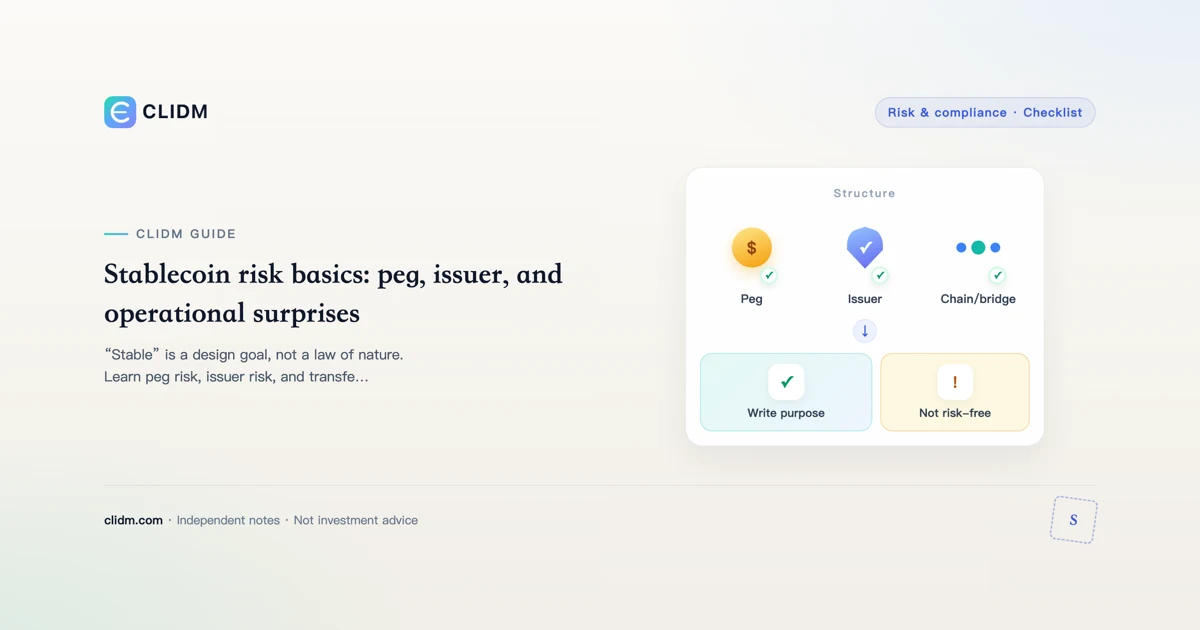
Stablecoin risk basics: peg, issuer, and operational surprises
Stablecoins aim to track a reference (often a fiat unit). They are useful for transferring value and parking working capital—but “stable” is a product claim and market outcome, not a physical constant.
Risk layer 1: Peg and market
Prices can trade away from the target during stress, liquidity gaps, or confidence shocks. How far and how long depends on the design, markets, and redeemability paths. Treat temporary depegs as possible—even if rare for majors—when sizing working capital.
Risk layer 2: Issuer and reserves
Many stablecoins depend on an issuer, banking partners, attestations/audits of varying quality, and compliance freezes. Reading primary documents beats memes. Understand—at a high level—what backs the coin and who can freeze addresses if that applies.
Risk layer 3: Smart contract and chain
On-chain versions inherit contract and bridge risks when you leave simple custodial balances. Bridged “wrappers” can add extra failure modes. Prefer understanding which contract you hold before you hold size.
Risk layer 4: Operational (where beginners actually lose)
- Wrong network deposits
- Memo/tag mistakes
- Phishing clone sites for “faster USDT”
- Confusing similarly named tokens
- Parking life-changing sums as “cash” without a written plan
Operational risk is not less real because the unit is called stable.
Practical beginner uses (with guardrails)
- Learning transfers with tiny tests
- Working capital sized to near-term needs—not “everything forever”
- Reducing conversion churn while studying markets—not as a free risk-free yield promise
Avoid: chasing the highest “stable yield” from unknown platforms.
Questions before you size up
- What is my purpose for holding this coin for the next 30 days?
- Can I explain issuer freeze/redeem basics in plain language?
- Have I tested the exact deposit/withdrawal route?
- What fraction of total net worth is too much even if the peg holds?
- Am I confusing convenience with safety?
Diversification caveats
Holding five tickers that all depend on similar banking and confidence shocks may not diversify as much as a spreadsheet suggests. Diversification is about uncorrelated failure modes—not ticker count.
Closing standard
Stablecoins are tools. Tools have failure modes. CLIDM teaches you to name those modes before you treat any ticker as a mattress.
Exchange-held vs self-held stablecoins
On an exchange, you hold an IOU subject to platform and account risks. In self-custody, you hold tokens subject to key and chain risks. Moving between them reintroduces deposit/withdrawal operational risk. Choose the custody mode that matches your horizon and training—not the loudest slogan.
Stress checklist (print-sized)
- Purpose written for next 30 days
- Route tested with tiny size
- Issuer freeze/redeem basics understood at high level
- Not treating all stable tickers as identical
- Max allocation cap written in cash terms
- No yield from platforms you cannot explain
If boxes are blank, keep amounts educational.
Decision log template
Write offline before you act: (1) skill I am practicing today, (2) maximum money I can lose without panic, (3) actions I refuse under social pressure, (4) the exact official domain I bookmarked myself. Keep the log boring—boredom is a feature.
CLIDM quality bar
We optimize for checklists, failure modes, and order of operations. We do not publish trade signals or guaranteed outcomes. Product UIs and fee schedules change; re-open official pages before you move size. Last reviewed: 2026-07-27.
Educational content only. Not investment, legal, or tax advice. Digital assets can lose value. Availability differs by region.
Four risk layers
Peg/market; issuer/reserves/freezes; contract/chain/bridge; operational (wrong network, phishing, life-changing “cash” parking). Convert costs are separate—see stablecoin spreads.
Questions before size
30-day purpose? Issuer freeze/redeem basics in plain language? Route tested? Max net-worth fraction even if peg holds? Confusing convenience with safety?
Stable is a product claim, not a law of nature
Issuer, reserve, redemption, and chain-bridge risks differ. Treat large stablecoin balances with the same custody hygiene as volatile coins: platform risk, account risk, and smart-contract risk still apply.
Beginner guardrails
- Diversify venue risk if size is meaningful
- Prefer official mint/redeem paths over random bridges
- Read depeg history as process lessons, not memes
Operational scenarios beginners actually hit
- Venue pause on withdrawals during stress
- Choosing a chain with high fees “because it is popular”
- Bridging through an unverified UI to chase yield
- Keeping payroll-sized stablecoins on a hot exchange account with weak 2FA
Each is a process choice, not bad luck.
Diligence questions (issuer and venue)
Who attests reserves, how often, and under what standards? How does redemption work for retail size? Which chains are official? What happened in prior depeg hours—did the venue halt, haircut, or process normally?
Portfolio role statements
Write one sentence: “I use stablecoins for ___ within a max of ___ cash.” If the blank is “because Twitter said it is safe yield,” rewrite before sizing up.
Related reading
Custody vs seed, cold vs exchange, fees.
Operator close-out for stablecoin risk basics
Before you increase size on this topic, freeze three written lines in a private note: (1) the single main risk in plain words, (2) the cash you can lose without changing rent/food plans, (3) the official URL or app path you will use—no chat links. If any line is blank, you are still in research mode.
Scenario table (fill with your numbers)
| Scenario | What you will do | What you will not do |
|---|---|---|
| Calm weekday | Follow checklist | Expand size on impulse |
| After a loss | Journal first | Revenge trade |
| Travel / new device | Re-verify bookmarks + 2FA | Withdraw large sums |
| Stranger urgency | Slow down | Share codes or seeds |
Common process failures unique to rushed readers
- Skimming only the intro and assuming the middle is marketing
- Treating one successful tiny action as a lifetime license to size up
- Saving secrets in the same cloud album as family photos
- Updating the app and assuming menus and fee labels stayed put
- Borrowing confidence from group chat screenshots instead of primary docs
Seven-day micro-curriculum
Day 1: re-read this guide slowly and highlight unknowns.
Day 2: open only official docs for the product surfaces mentioned.
Day 3: complete security hygiene if the topic touches accounts.
Day 4: paper the steps without value, or with dust if transfers apply.
Day 5: one real micro action at boring size.
Day 6: journal fees, emotions, and mistakes.
Day 7: decide explicitly to pause or continue—with a cash cap.
Refusal lines worth rehearsing
“I do not move funds from links in messages.”
“I do not share recovery words with support.”
“I do not increase size to win back a loss.”
“I can leave money uninvested while I learn.”
How this page connects to the rest of CLIDM
Use the learning path for sequence, the security hub for account controls, and topic siblings linked above for depth. CLIDM optimizes for checklists and refusal skills—not trade calls. Re-check live UI labels after every major app release; educational articles lag product copy on purpose.