
Fees & tools
How to read crypto trading fees (maker, taker, VIP, withdrawals)
Maker vs taker, VIP tiers, spreads, and withdrawal costs—what actually hits your balance.
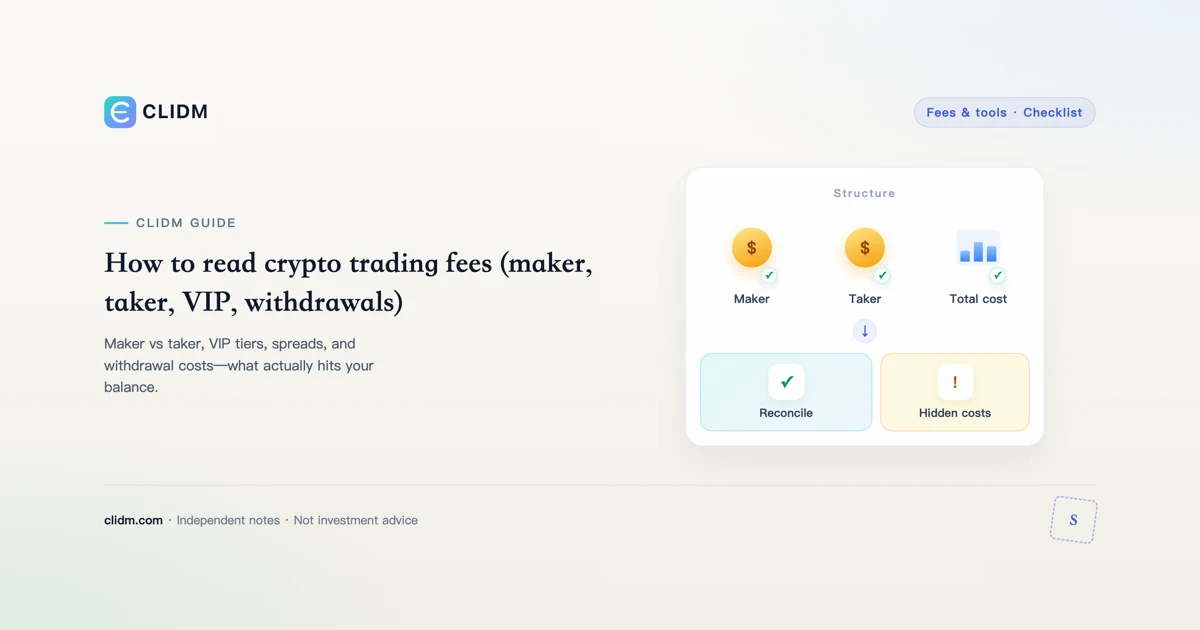
How to read crypto trading fees without getting surprised
Live public fee page (screenshot)
Captured from the public OKX trading fee schedule at okx.com/fees (viewport capture, 2026-07-27). Use it to see how maker/taker and VIP tiers are presented — numbers change; re-check the live page before trading.

Source: okx.com/fees · educational citation only · not a full-page reprint of marketing content.
Teaching screenshot: how fee tables usually look
Public fee pages typically list level, volume, maker, and taker. The image is a CLIDM educational mock (not a live exchange UI). After studying it, open a real public fee page such as okx.com/fees and verify current numbers yourself.

Figure: Educational mock for teaching. Placeholder percentages only.
Fee layers map

Fee pages look simple until your balance moves by less than the chart suggests. Break costs into layers.
Layer 1: Trading fees (maker / taker)
- Maker: you add liquidity (limit order that rests on the book)
- Taker: you remove liquidity (market order or marketable limit)
Taker fees are often higher. If you always mash “market,” you pay for convenience.
Layer 2: VIP / volume tiers
Many platforms lower fees as 30-day volume rises. That helps active traders—not necessarily beginners. Do not force volume just to chase a tier.
Layer 3: Spreads and “zero fee” marketing
A zero trading-fee pair can still embed cost in the bid–ask spread or in conversion rates. Compare all-in proceeds, not the headline badge.
Layer 4: Funding and financing (derivatives)
Perpetual futures may charge funding. Holding a leveraged position overnight can cost more than the entry fee. If you do not understand funding, do not hold perps.
Layer 5: Deposits and withdrawals
- Fiat rails may have bank or third-party fees
- Crypto withdrawals usually charge a network fee set by the platform (not always identical to on-chain minima)
- Wrong-network deposits can mean permanent loss
A 5-minute pre-trade habit
- Open the fee schedule for your account level
- Note maker vs taker for the pair
- Estimate round-trip cost (buy + sell)
- Check withdrawal fee before you need urgency
- Avoid stacking leverage fees on top while learning
Why this matters for education sites
Reviews that only say “low fees” without defining maker/taker or VIP thresholds are incomplete. On CLIDM we treat fee literacy as a core skill—not a slogan.
Educational only. Schedules change; verify on the platform.
Worked example of thinking in all-in costs
Suppose you buy and later sell the same spot pair. You pay a taker fee twice if both orders lift liquidity, plus any spread between bid and ask at the moments you traded, plus a network fee if you withdraw on-chain later. Promotions that waive the trading fee line can still leave you worse off if spreads widen. Always estimate proceeds after every layer, not after the badge on a landing page.
Questions to ask before you care about VIP tiers
Will you actually trade enough volume for a tier to matter this month? Does chasing volume change your risk behavior? Are you paying more in mistakes and leverage costs than you save in basis points? For most beginners, readable fees and reliable withdrawals beat an aggressive fee schedule you do not understand.
Documentation habits that prevent surprises
Screenshot or save the fee schedule version you relied on when comparing platforms. Note your account level. When the interface changes, re-check maker and taker rows for the pairs you use. If a tutorial cites numbers without a date, treat them as possibly stale.
How education sites should talk about fees
Fee claims should define maker versus taker, mention VIP thresholds when relevant, and separate trading fees from deposit, withdrawal, and funding costs. Anything less is marketing language, not literacy.
Summary
Read fees as a stack: trading, VIP context, spreads, derivatives financing, and transfer costs. Build a five-minute pre-trade habit and verify schedules on the platform itself before you size positions.
Practical appendix: decision log template
Before you act, write four lines offline: (1) what I am trying to learn this week, (2) maximum cash I will deposit for learning, (3) actions I will never take under social pressure, (4) the official domain I bookmarked with my own hands. This simple log reduces impulsive clicks more than any hot take on social media.
How CLIDM measures “done enough”
A guide is done enough when a careful reader can finish a task without opening ten tabs, when risks are named without theater, and when commercial links—if any—are rare and labeled. We would rather publish fewer stronger pages than a swarm of thin variants. When product interfaces change, we update the checklist language rather than pretending screenshots stay eternal.
Related reading path
After this page, read the security checklist, then the fee layers guide, then the careful registration flow only if you still need an account. Skip leverage content until spot operations feel boring. That sequence is intentional for beginners who want to survive long enough to learn.
Official fee schedule example (public page)

Screenshot of a public exchange fee schedule for literacy only. Rates change—always re-open the official page via your bookmark before you size up. Last captured for CLIDM education notes.
Fee ritual
Bookmark schedule; spot vs derivatives; maker/taker/VIP/exclusions; predict then reconcile tiny fill; spreads may dwarf fees.
Log template
Date; domain; action; checklist done; size reason; fee; emotion; lesson; next allowed date.
Educational content only. Not investment, legal, or tax advice. Digital assets can lose value. Re-check official pages via bookmark. Last reviewed: 2026-07-27. Learning path.