
Fees & tools
The real cost of a round trip: what buying and selling actually takes
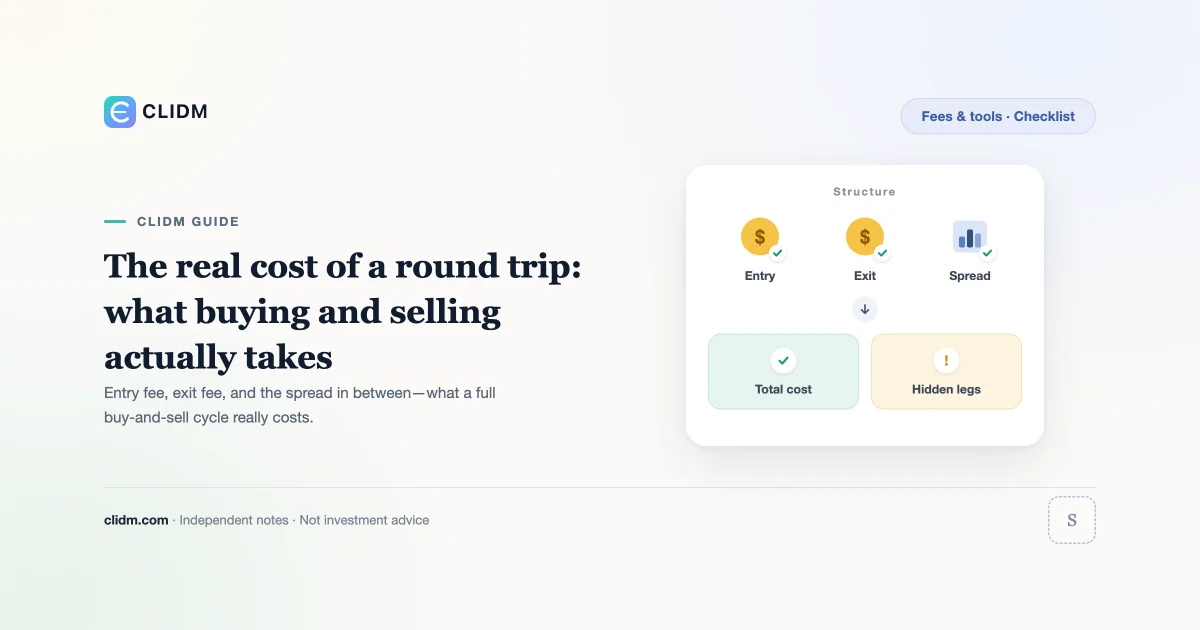
Entry fee, exit fee, and the spread in between—what a full buy-and-sell cycle really costs.
The real cost of a round trip: what buying and selling actually takes
Most beginners price a trade by looking at one number: the trading fee. But a position you open and later close has at least four cost components, and only one of them is printed on the fee schedule.
What a round trip means
A round trip is one full cycle: you buy, you hold, you sell. Nothing is realised until the second leg completes. Any honest cost estimate has to include both legs and everything that leaks in between.
The four components
1. Entry fee. Charged when your buy order fills. Whether you pay the maker or taker rate depends on your order type, not your intention.
2. Exit fee. Charged again when you sell. This is the leg beginners forget. Two legs means the trading fee applies twice.
3. The spread. The gap between the best bid and the best ask. You cross it on the way in and potentially again on the way out. It is not itemised anywhere on your statement, which is exactly why it goes unnoticed.
4. Slippage. If your order is larger than the resting liquidity at the best price, the remainder fills at worse prices. In thin books this can exceed the fee itself.
Add funding or borrowing costs if the position is leveraged, and network fees if the assets move on or off the platform.
Why this changes the arithmetic
A move in your favour has to cover all of the above before you are flat, and more than that before you are ahead. The smaller and more frequent your trades, the more of these fixed frictions you pay per unit of exposure.
This is the mechanical reason that high trade frequency is expensive for beginners. It is not a claim about whether any particular trade is wise—it is arithmetic that applies before any market opinion enters.
How to estimate it before you act
- Open the live fee schedule for your account tier and read both the maker and taker rates.
- Decide which one your intended order type will actually pay.
- Double it—one for entry, one for exit.
- Look at the order book and note the current spread as a percentage.
- Compare the total against the move you would need to break even.
Write the number down before the trade, not after. The estimate stops being useful the moment it becomes a rationalisation.
Failure modes
- Quoting only the entry fee and treating the exit as free
- Assuming the maker rate applies when placing a market order
- Ignoring the spread because it never appears as a line item
- Comparing venues on headline fees while ignoring liquidity
- Forgetting that a promotional rate has an expiry
- Counting a position as profitable before the second leg has filled
A cost note worth keeping
For each venue you use, record: your current tier, the maker rate, the taker rate, the typical spread on the pairs you actually touch, and the date you checked. Re-check after any tier change or fee announcement. This takes minutes and removes most of the guesswork.
What this does not tell you
Knowing your round-trip cost does not tell you whether to trade, what to trade, or when. It only tells you the height of the bar you are trying to clear. CLIDM does not publish signals or forecasts; we publish the arithmetic that applies regardless of direction.
How this page connects to the rest of CLIDM
Start with the learning path. For the fee mechanics, read how to read trading fees and maker vs taker fees. For order types, see market vs limit orders and reading the order book. For what "zero fee" usually means, see zero-fee trading explained.
CLIDM quality standard
We optimise for checklists, failure modes, and operating order—not trade signals or return guarantees. Interfaces and fee schedules change; reopen the official page before increasing size. Last reviewed: 2026-08-25.
Educational only. Not investment, legal, or tax advice. Digital assets can lose value. Availability varies by region.