
Beginner basics
A trading journal for beginners who want skills, not screenshots
Journals beat vibes. Track process, size, fees, and emotional state—not just green and red.
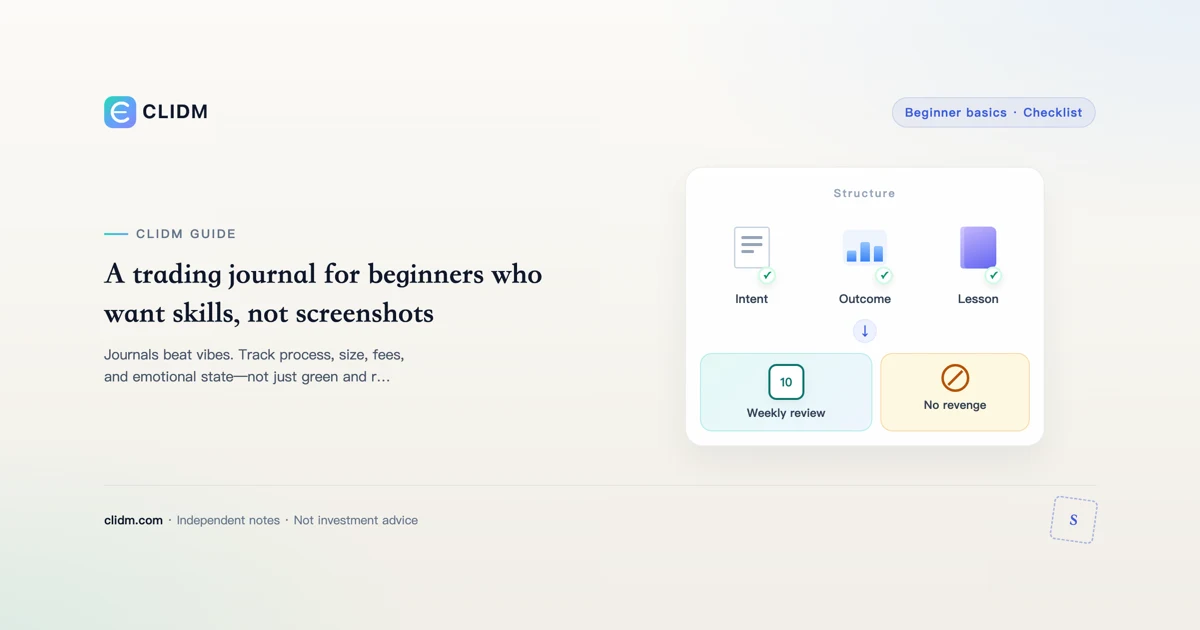
A trading journal for beginners who want skills, not screenshots
If you only remember the wins, you will scale the wrong habits. A journal is a cheap instrument that turns noise into feedback—especially while sizes are still small.
What a beginner journal is for
- Catching repeated process errors (wrong network, skipped test, FOMO market buys)
- Separating market luck from checklist quality
- Building the emotional vocabulary to stop when heart rate is high
- Creating a record you can review weekly without social media theater
It is not for proving you are a genius or producing content for strangers.
Minimum fields (copy this)
- Date / time / market session
- Pair and venue (bookmarked domain only)
- Intent in one sentence
- Order type and why
- Planned size and max loss in cash terms
- Actual fill / fee notes
- Checklist score: security steps done? (Y/N)
- Emotional state before (calm / rushed / angry / euphoric)
- Result vs plan (not just PnL)
- One sentence lesson
Optional: screenshot stored privately, never with secrets visible.
What not to log obsessively
- Every tick of the order book
- Influencer opinions
- Fantasies about what you “would have made” on a size you did not take
- Other people’s trades
Weekly review ritual (20 minutes)
- Count checklist failures.
- Highlight any trade taken while rushed or angry.
- Note fee surprises.
- Pick one process fix for next week (not ten).
- If leverage appeared without a written plan, write a stop rule.
Red-flag patterns in journals
- Size creeping up after wins
- Stops widened after entry
- “I will make it back today” language
- Missing security steps when PnL is exciting
- Blank intent fields filled after the fact
Paper vs live journaling
Paper trading journals teach UI vocabulary. Live tiny journals teach fear and fee reality. Do not skip the live tiny stage if your goal is real-world competence—but keep it tiny.
Privacy
Journals may reveal account patterns—keep offline or private vault. Do not post full journals with balances. Link to first spot checklist.
Closing standard
A journal that only tracks PnL is a scoreboard. A journal that tracks process is a coach. CLIDM prefers coaches—especially for beginners who still confuse entertainment with skill.
Example journal entry (fictional, educational)
- Date: 2026-07-20 21:10
- Pair: BTC/USDT spot on bookmarked venue
- Intent: practice limit buy discipline after checklist
- Order: limit, because I refuse to chase last print
- Size: learning amount I can lose without mood change
- Security: bookmark login, 2FA ok, no new device
- Emotion before: slightly rushed after social feed → waited 10 minutes
- Outcome vs plan: partial fill; cancelled rest; fees matched prediction
- Lesson: social feed before tickets raises rush score—sequence is feed → walk → ticket
Copy the structure; do not copy anyone’s size or signals.
Linking journal to security
Once a month, add a security row: sessions reviewed, API keys count, allowlist status, backup codes still readable. Trading skill without security skill is incomplete literacy.
Decision log template
Write offline before you act: (1) skill I am practicing today, (2) maximum money I can lose without panic, (3) actions I refuse under social pressure, (4) the exact official domain I bookmarked myself. Keep the log boring—boredom is a feature.
CLIDM quality bar
We optimize for checklists, failure modes, and order of operations. We do not publish trade signals or guaranteed outcomes. Product UIs and fee schedules change; re-open official pages before you move size. Last reviewed: 2026-07-27.
Educational content only. Not investment, legal, or tax advice. Digital assets can lose value. Availability differs by region.
Minimum fields that matter
Date, pair, venue domain, intent skill, order type why, max cash loss, fee notes, security checklist yes/no, emotion, result vs plan, one lesson. Weekly review: count checklist fails; highlight rushed trades; pick one process fix.
What to log (minimum fields)
Date, market, intent (learn vs profit), size in cash terms, fees paid, emotion before/after, rule followed or broken, one lesson. Screenshots optional; honesty is not.
Weekly review questions
- Did I increase size after wins without a written rule?
- Did chat urgency cause entries?
- Which fee surprises repeated?
- What will I forbid next week in one sentence?
Example entries (fictional)
Entry A: Spot buy limit, learning fees; felt calm; followed size rule; lesson: wait for full fill before screenshots.
Entry B: Almost opened 5× after group ping; journaled urge; did not trade; lesson: mute channel during sessions.
Tag system that stays small
Use at most five tags: learn, fee-surprise, tilt, process-win, skip. If everything is tagged alpha, the journal is cosplay.
Monthly roll-up
Count process-wins vs tilts. If tilts dominate, cut size or pause. Journals that only list prices become diaries of noise.
Operator close-out for trading journal for beginners
Before you increase size on this topic, freeze three written lines in a private note: (1) the single main risk in plain words, (2) the cash you can lose without changing rent/food plans, (3) the official URL or app path you will use—no chat links. If any line is blank, you are still in research mode.
Scenario table (fill with your numbers)
| Scenario | What you will do | What you will not do |
|---|---|---|
| Calm weekday | Follow checklist | Expand size on impulse |
| After a loss | Journal first | Revenge trade |
| Travel / new device | Re-verify bookmarks + 2FA | Withdraw large sums |
| Stranger urgency | Slow down | Share codes or seeds |
Common process failures unique to rushed readers
- Skimming only the intro and assuming the middle is marketing
- Treating one successful tiny action as a lifetime license to size up
- Saving secrets in the same cloud album as family photos
- Updating the app and assuming menus and fee labels stayed put
- Borrowing confidence from group chat screenshots instead of primary docs
Seven-day micro-curriculum
Day 1: re-read this guide slowly and highlight unknowns.
Day 2: open only official docs for the product surfaces mentioned.
Day 3: complete security hygiene if the topic touches accounts.
Day 4: paper the steps without value, or with dust if transfers apply.
Day 5: one real micro action at boring size.
Day 6: journal fees, emotions, and mistakes.
Day 7: decide explicitly to pause or continue—with a cash cap.
Refusal lines worth rehearsing
“I do not move funds from links in messages.”
“I do not share recovery words with support.”
“I do not increase size to win back a loss.”
“I can leave money uninvested while I learn.”
How this page connects to the rest of CLIDM
Use the learning path for sequence, the security hub for account controls, and topic siblings linked above for depth. CLIDM optimizes for checklists and refusal skills—not trade calls. Re-check live UI labels after every major app release; educational articles lag product copy on purpose.