
Security
P2P trading risks: frozen bank cards, fake receipts, and appeal reality
Escrow protects the coins, not your bank account. What P2P actually exposes you to.
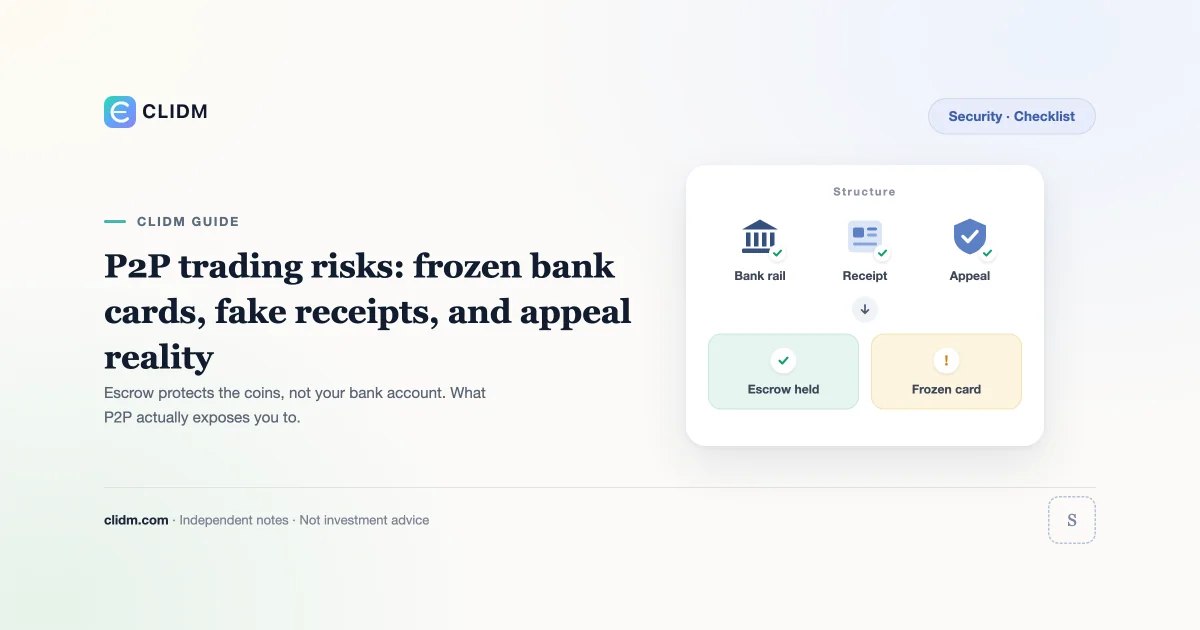
P2P trading risks: frozen bank cards, fake receipts, and appeal reality
Peer-to-peer trading moves crypto between two users with the platform holding the coins in escrow. Escrow solves one problem well. It does not touch the problem that hurts most beginners: what happens on the bank side.
What escrow actually protects
When a P2P trade opens, the seller's crypto is locked by the platform. It is released to the buyer only when the seller confirms payment received, or when an appeal is decided. That mechanism reliably protects the coins.
It does not protect your bank account, your payment method, or your legal position if the money arriving in your account came from somewhere it should not have. That asymmetry is the whole risk profile of P2P.
The frozen card problem
If a counterparty pays you with funds that are later reported as fraudulent, your receiving account can be restricted while the payment is investigated. This can happen even when you did nothing wrong and completed the trade exactly as instructed.
Ways people reduce exposure:
- Use a payment method and account you can afford to have restricted temporarily
- Prefer counterparties with substantial completed volume and a long account history
- Keep the trade inside the platform's chat and payment rails so there is a record
- Avoid transfers where the sender name does not match the counterparty's verified name
- Refuse payments arriving from a third party, however plausible the explanation
- Keep records: order ID, timestamps, and the payment reference
None of these eliminate the risk. They reduce how often it lands on you and improve your position if it does.
Fake payment receipts
A common attack is a forged transfer confirmation—an edited screenshot, a pending transaction that will be reversed, or a payment to a similar-looking account. The seller sees a convincing image and releases the crypto.
The rule that defeats this: release only after the funds are confirmed in your own account balance, checked in your own banking app, opened independently. Not a screenshot, not an SMS, not a pending notification, not a message in the platform chat. A screenshot is a picture, not a settlement.
How appeals actually work
Appeals are decided on evidence the platform can verify. That usually means the in-platform chat log, the order record, and documents both sides upload.
This has consequences for how you should behave during a trade:
- Keep every message inside the platform chat; a WhatsApp or Telegram conversation is often outside what can be reviewed
- Never mark a payment as sent before sending it
- Never release early "as a favour" or because of urgency
- Save your own evidence at the time, not afterwards
- Expect appeals to take time and to sometimes end in a way you disagree with
Urgency is the most reliable tell. A counterparty applying time pressure is managing you, not the trade.
Region and legality
P2P availability, payment methods, and the legal treatment of these transactions vary significantly by jurisdiction, and change. CLIDM does not advise on whether P2P is appropriate or lawful where you are. Check current local rules and your bank's terms before using it. This is one of the topics where a general guide cannot substitute for local information.
Failure modes
- Releasing crypto based on a screenshot
- Moving the conversation off-platform
- Accepting payment from a name that does not match the counterparty
- Using a primary salary account for P2P volume
- Trading with brand-new accounts because the price is slightly better
- Marking as paid to "hold" a rate before actually paying
How this page connects to the rest of CLIDM
Use the security hub for account controls and the learning path for sequence. Related: fiat on-ramp risks, social media crypto scams, and how to evaluate a crypto exchange.
CLIDM quality standard
We optimise for checklists, failure modes, and operating order—not trade signals or return guarantees. Rules and availability change by region; check local requirements before acting. Last reviewed: 2026-08-25.
Educational only. Not investment, legal, or tax advice. Digital assets can lose value. Availability varies by region.