
Risk & compliance
Proof of reserves literacy: what it shows and what it cannot
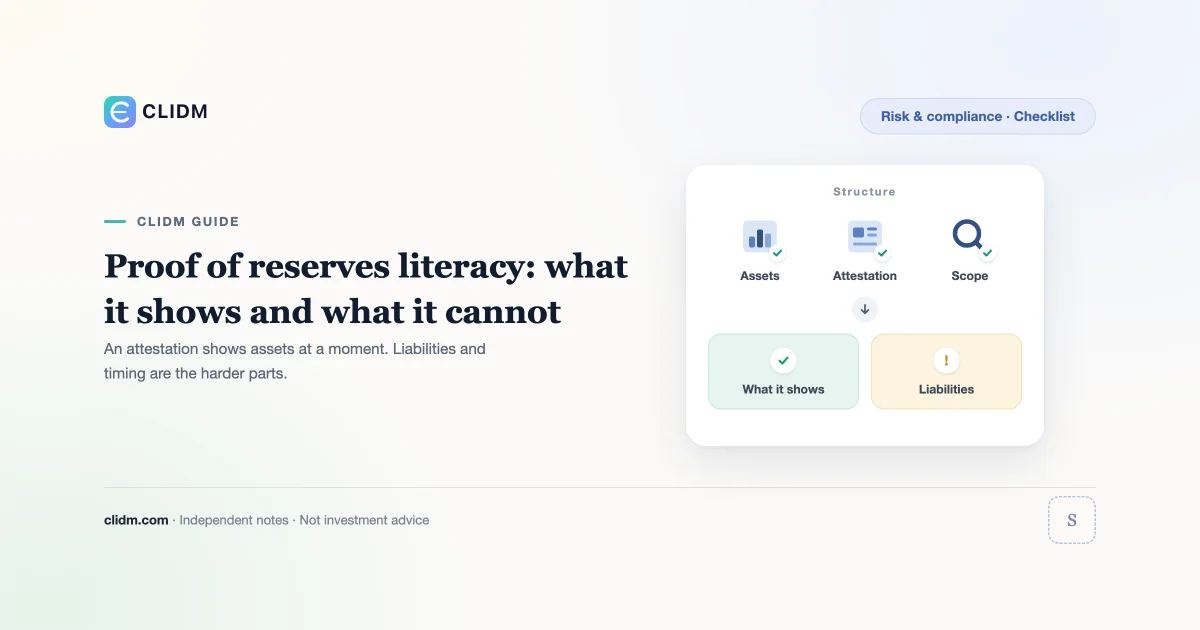
An attestation shows assets at a moment. Liabilities and timing are the harder parts.
Proof of reserves literacy: what it shows and what it cannot
After several exchange failures, proof of reserves became a standard trust signal. It is a genuine improvement over nothing. It is also routinely read as proving far more than it does.
What a proof of reserves attempts
The basic idea has two halves:
Assets. Demonstrate control of on-chain holdings, typically by publishing addresses and signing messages from them.
Liabilities. Demonstrate what the venue owes customers, often via a cryptographic structure that lets an individual user verify their own balance is included without revealing everyone else's.
Together, these aim to show that customer holdings are backed. The assets half is comparatively easy to verify. The liabilities half is where the difficulty lives, and where published reports vary most in rigour.
What it genuinely gives you
- Evidence that specific addresses held specific balances at a moment in time
- A way, on some venues, to check that your balance was included in the liability set
- A repeated commitment that creates a public track record over time
- A signal about a venue's willingness to be examined at all
Those are real. A venue publishing regular, verifiable attestations is telling you something meaningful about its posture.
What it cannot show
It is a snapshot. It describes one moment. Balances can change immediately afterwards.
Borrowed assets look identical to owned assets. Demonstrating control of coins at a point in time does not demonstrate that they were not borrowed to be there. This is the single most important limitation, and the reason timing matters.
Off-chain liabilities may be invisible. Debts, loans, and obligations that do not appear on-chain may sit entirely outside the exercise.
Scope may be partial. Some reports cover selected assets, entities, or subsidiaries. Group structures can be complex, and what is excluded is often more informative than what is included.
It says nothing about legal segregation. Whether customer assets are protected in an insolvency is a legal question determined by jurisdiction and corporate structure, not by an attestation.
It is not an audit. An attestation by an accounting firm, performed under agreed procedures, is a narrower thing than a full financial audit, and the two are frequently conflated in marketing.
How to read a report
- Check the date, and how often reports are published.
- Check the scope: which assets, which legal entities.
- Check who performed it and under what standard.
- Check whether liabilities are covered, or only assets.
- Check whether you can verify your own balance's inclusion.
- Check what the report itself states it does not cover—reputable ones say so.
- Compare across periods; a single report says less than a consistent series.
Failure modes
- Reading "proof of reserves" as "your funds are safe"
- Treating an assets-only publication as a full picture
- Assuming an attestation is an audit
- Ignoring the date and the gap between reports
- Never checking your own inclusion when the tool is offered
- Letting a single trust signal replace the rest of your evaluation
Where it fits
Proof of reserves is one input among many: regulatory status, operating history, jurisdiction, withdrawal reliability, and how the venue behaves under stress. It belongs on the checklist. It does not replace the checklist. And it does not change the underlying reality that assets on any venue are held by that venue—which is a custody decision, not a technical one.
How this page connects to the rest of CLIDM
Use the learning path for sequence. Related: how to evaluate a crypto exchange with a neutral checklist, cold storage vs exchange balance, exchange custody vs seed phrase wallets, and 10 things to know before your first exchange.
CLIDM quality standard
We optimise for checklists, failure modes, and operating order—not trade signals or return guarantees. Disclosure practices and regulations change; read the current report and its stated scope. Last reviewed: 2026-08-25.
Educational only. Not investment, legal, or tax advice. Digital assets can lose value. Availability varies by region.