
Risk & compliance
When a withdrawal goes under review: what actually happens next
Reviews are a process, not a verdict. What triggers one and how to respond calmly.
When a withdrawal goes under review: what actually happens next
You request a withdrawal and it does not leave. The status says pending review, additional verification, or risk control. Nothing is confirmed, no one has explained anything, and the natural instinct—try again, then again—is the one that makes it worse.
What a review is
Regulated venues run automated checks on withdrawals. When something falls outside the expected pattern for your account, the request is held for a human or a secondary system to look at. It is a process step, not a verdict, and not an accusation.
Reviews are also frequently protective. If an attacker gained access to an account, the withdrawal review is often the last control standing between them and the balance.
Common triggers
- A first withdrawal, or a first withdrawal to a new address
- An amount or frequency well outside your history
- A recent change to security settings, password, or 2FA
- Login from a new device, country, or network
- A newly added payment method or bank account
- Periodic re-verification of identity documents
- Sanctions and jurisdiction screening
- Destination address flagged by the venue's screening provider
Most triggers are pattern-based, which is why routine behaviour rarely produces them and unusual behaviour reliably does.
What to do
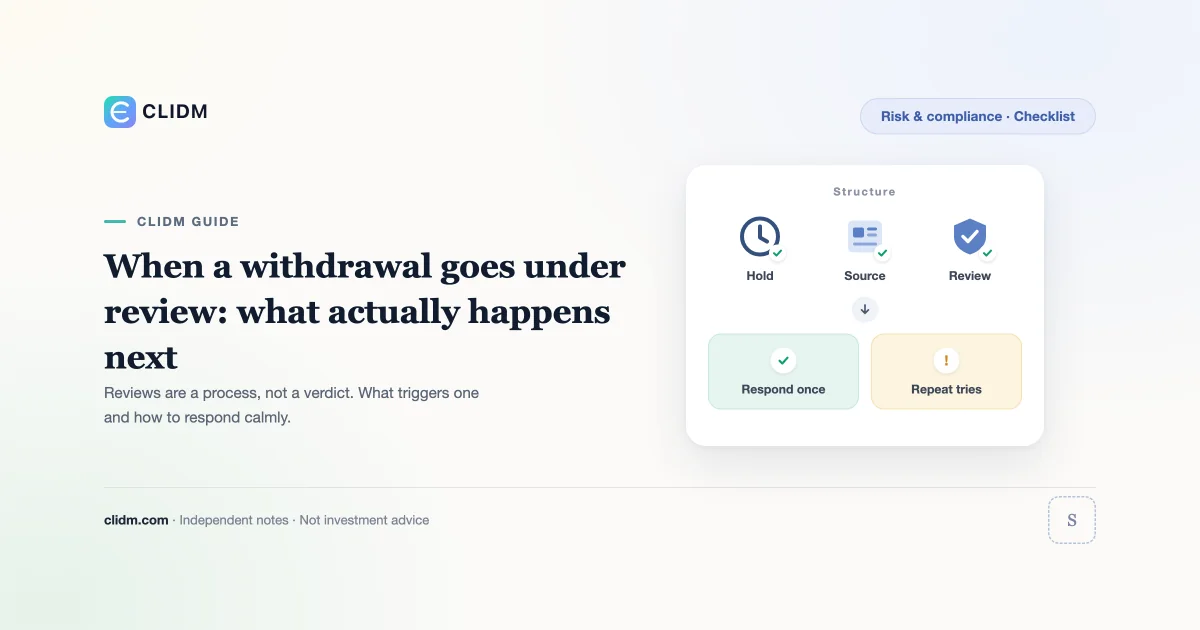
- Stop submitting. Repeat attempts create duplicate cases and can look like the pattern the check exists to catch.
- Read the notice carefully. If a specific document or confirmation is requested, that is the whole task.
- Check the account's message centre, not just email. Requests are often posted in-platform.
- Respond once, completely. Provide exactly what was asked, in the format asked.
- Use official channels reached by your own bookmark. Never a link from a message or a search advertisement.
- Wait the stated window before following up, then follow up in the same ticket.
- Keep your own record: request time, amount, destination, ticket number, screenshots.
What is usually requested
Proof of identity, proof of address, a source-of-funds explanation, confirmation that the destination address is yours, or a re-verification step. Source-of-funds questions surprise people, but they are standard in regulated finance and are usually answered with ordinary documentation such as records of the transactions that funded the account.
This is a good reason to keep clean records before you need them, and to record transactions as they happen rather than reconstructing them under pressure later.
The scam that follows a stuck withdrawal
Users publicly complaining about a frozen withdrawal are targeted immediately. The reply offering to escalate your case, the "senior agent" who messages first, the fee you must pay to release the funds—all of it follows the same script.
Support does not contact you first, does not work through social DMs, never asks for your password, 2FA codes, or remote access, and no legitimate venue asks for an upfront payment to release your own withdrawal. See crypto phishing email red flags and social media crypto scams.
Reducing how often this happens
- Whitelist withdrawal addresses in advance (withdrawal whitelist setup)
- Make a small test withdrawal to establish a route before you need it
- Avoid withdrawing immediately after changing security settings
- Keep identity documents current before they expire
- Build a boring, consistent pattern of activity
What CLIDM cannot tell you
We cannot tell you why a specific review was triggered, how long yours will take, or what the outcome will be. Only the venue can, and only through its official channel. Anyone else claiming to know is guessing or working an angle.
How this page connects to the rest of CLIDM
Use the learning path and the security hub. Related: KYC prep checklist, the small test withdrawal habit, and how to evaluate a crypto exchange.
CLIDM quality standard
We optimise for checklists, failure modes, and operating order—not trade signals or return guarantees. Policies and requirements vary by region and change; confirm through official channels. Last reviewed: 2026-08-25.
Educational only. Not investment, legal, or tax advice. Digital assets can lose value. Availability varies by region.