
Beginner basics
Crypto record keeping basics: reconcile before you need to
Exports go stale and accounts close. Reconcile while the records still exist.
Crypto record keeping basics: reconcile before you need to
Records feel like an afterthought until the moment you need them. Then you discover the export window closed, the platform changed its format, the account you used is gone, and the transfers you made two years ago no longer explain themselves.
Why this is a beginner topic
Record keeping is usually filed under tax, which makes people postpone it. But the reasons you need records arrive much earlier than any filing deadline:
- A withdrawal review asks how the account was funded
- A support ticket needs a transaction ID from months ago
- You want to know whether an activity is actually profitable after costs
- An account is closed, restricted, or a service shuts down
- You need to reconstruct what happened after a mistake
Every one of these is easier with contemporaneous records and painful without them.
What to capture
For each transaction, the useful fields are consistent:
- Date and time, with timezone
- Platform or wallet
- Type: buy, sell, swap, deposit, withdrawal, transfer between your own accounts
- Asset and amount
- Price or rate at the time
- Fees, separated into trading fee and network fee
- Transaction ID or order ID
- Source and destination
- A short note explaining why, in your own words
That last field is the one everyone skips and later wishes they had. Six months on, "moved USDT to exchange B for lower withdrawal fee" is worth more than any amount of reconstruction.
The habit that makes it sustainable
Do not attempt this from memory at year end. Instead:
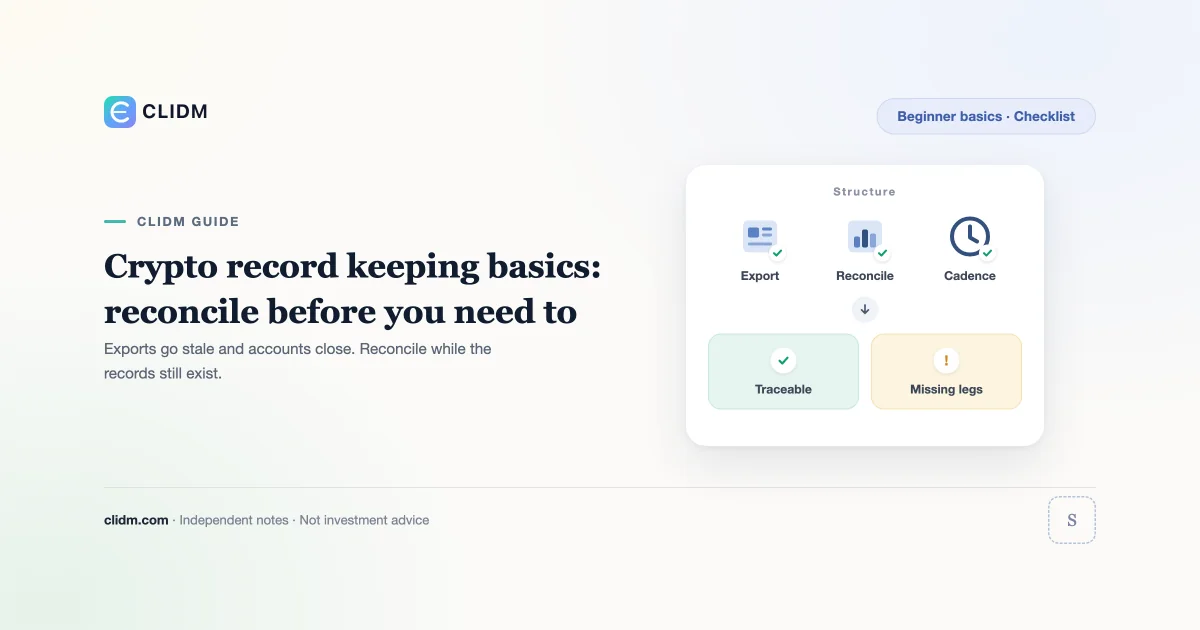
- Export monthly. Download the trade, deposit, and withdrawal history from each platform you use, and store it somewhere durable that is not the platform itself.
- Reconcile monthly. Confirm the balance your records imply matches the balance actually shown.
- Investigate differences while they are small. A discrepancy is easy to explain within weeks and nearly impossible after a year.
- Keep the raw exports, not just a summary. Formats change; original files preserve detail you did not know you needed.
- Record transfers between your own accounts explicitly. These are not disposals, but they look like them in a naive reconstruction, which is a common source of confusion.
Monthly is the cadence that works, because it is short enough that you still remember what happened.
Where records go stale
Exports have limits: a maximum lookback period, a rate limit, a format that changes, or an account you can no longer log into. Every one of these is invisible until you need the data. That is the entire argument for exporting on a schedule rather than on demand.
Storage
Records contain account identifiers and balances, so treat them as sensitive. Encrypted storage, controlled access, and a backup that is not on the same device. Do not paste transaction history into chats or upload it to services you have not vetted. The security hub covers the wider account controls.
On tax
Tax treatment of digital assets varies substantially by jurisdiction and changes. CLIDM does not provide tax advice and cannot tell you what is reportable where you live. What we can say without qualification: good records make any local requirement dramatically easier, and no local rule is ever made easier by missing data. If your situation is non-trivial, the records are what let a qualified local professional help you efficiently.
Failure modes
- Relying on the platform to keep history indefinitely
- Exporting only when you need it, then finding the window closed
- Keeping summaries and discarding raw files
- Ignoring network fees as too small to record
- Failing to label self-transfers, then double-counting them
- Storing everything on one device with no backup
- Leaving the "why" field empty
How this page connects to the rest of CLIDM
Use the learning path for sequence. Related: a trading journal for beginners, the real cost of a round trip, when a withdrawal goes under review, and KYC prep checklist.
CLIDM quality standard
We optimise for checklists, failure modes, and operating order—not trade signals or return guarantees. Requirements vary by region and change; consult a qualified local professional for your situation. Last reviewed: 2026-08-25.
Educational only. Not investment, legal, or tax advice. Digital assets can lose value. Availability varies by region.